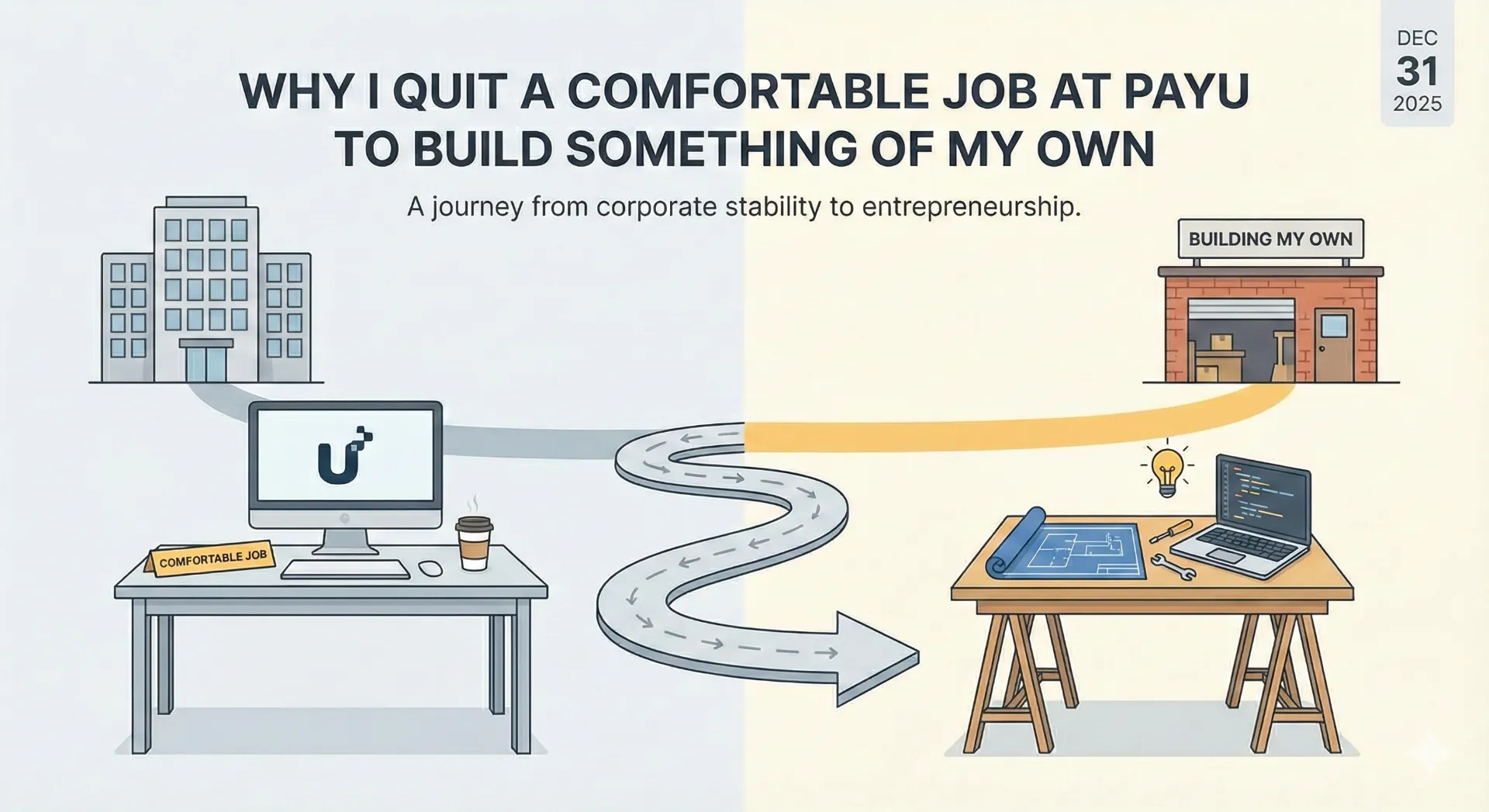
I didn’t quit my job at PayU because I was unhappy.
I was doing well. I had started as a Technical Lead, moved into an Engineering Manager role, worked on meaningful systems, and enjoyed the comfort that comes with a stable salary, brand name, and predictable life. There was no dramatic moment where I thought, “I can’t do this anymore.”
Instead, I quit because I wanted to build something of my own.
The thought that stayed for a year
The idea of entrepreneurship stayed with me for almost a year before I resigned. It wasn’t impulsive. I was 35 at the time, and I knew one thing clearly: ten years later, I wouldn’t have the same energy or risk appetite to try this.
India was changing. Startup India, Digital India, and a visible push toward technology-led governance were creating opportunities. I kept asking myself: If not now, when?
I didn’t want to remain an employee forever. Not because being an employee is bad, but because I wanted to experience the other side: building, hiring, taking responsibility, and eventually teaching my son what it means to create value as an owner.
Stability before uncertainty
Before quitting, I worked deliberately toward stability.
For me, stability didn’t mean a title or brand. It meant:
- A decent amount of savings and investments
- Health and term insurance in place
- No major liabilities like a home loan
- And most importantly, my wife believing in me
I prepared myself mentally for at least one year without income. That preparation gave me the confidence to take the leap.
The first people I told were my wife and my now co-founder.
The railway project that changed everything
The turning point came unexpectedly.
A classmate called me one day and said someone needed urgent help building software for the railways. I had zero experience with railway systems, but I’ve never hesitated when it comes to technology. I jumped in without overthinking.
That first Southern Railway project was accidental. The second one wasn’t.
We delivered well on the first, built trust, and secured the second project without competition. At that point, it felt like validation. We thought we had found a steady revenue stream. We were wrong.
Working with government bodies taught me lessons no corporate job ever could.
Reality hits hard
Government work doesn’t follow Agile. Or Waterfall. Or any framework you’ve read about.
There were:
- Frequent ad-hoc calls
- Requirement changes from different officials
- Officials getting transferred mid-project
- Expectations of “quick delivery” without understanding technical complexity
Psychologically, the shift from employee to accountable founder was massive. I was always reachable. Always responsible. Always worried about funding timelines.
And yes, I missed the predictability of a paycheck. I still do, sometimes.
At one point, we even had to let go of employees to survive.
That’s a kind of pain no leadership book prepares you for.
A moment I almost gave up
There was one moment when I truly thought quitting PayU was a mistake.
My house caught fire.
We lost the financial equivalent of three months’ salary. We were homeless for almost a month and had to stay with my in-laws. Thankfully, no one was home when it happened. I’m grateful for that every day.
Oddly enough, that incident pushed me forward. The loss didn’t destroy my financial base, and it reminded me why preparation mattered. I realized I could survive worse and still stand.
Building Plattr Tech Studio
We decided to formalize things and build Plattr Tech Studio instead of freelancing solo. My co-founder was ready to fund initially, and we hired fresh graduates, trained them through internships, and built the team from scratch.
In hindsight, one mistake stands out clearly:
We needed a co-founder with sales and marketing experience from day one.
Two tech co-founders work fine for government projects. They don’t work well for B2B SaaS.
That lesson was expensive.
Experiments, failures, and hard truths
Alongside government work, we experimented with B2B SaaS products, especially in e-commerce. The motivation was simple: government projects are not a steady income stream.
The products failed quietly.
Not because the tech was bad, but because we couldn’t focus, and we didn’t reach the market fast enough. That phase taught me a painful truth:
Building is easy. Selling is the hardest part.
Product–market fit isn’t about downloads or installs. It’s about whether customers are willing to pay and stay.
Identity shift
After leaving PayU, people started seeing me differently. I was no longer “working at a company.” I was running one. That came with respect — and pressure.
I had to unlearn corporate habits, live below my means, and accept that entrepreneurship is often worse than a 9-to-5 job in terms of uncertainty. But it’s also far more honest.
Could I go back to being an employee? Yes.
Would I stay there forever? No.
Looking back, honestly
Was quitting PayU the right decision? Yes.
I lost money. I lost comfort. But I gained clarity about people, markets, communication, and myself.
If I were to start again, I would do one thing differently:
I wouldn’t quit my full-time job until there was clear revenue and paying customers.
Ideas don’t pay bills. Customers do.
One sentence I wish someone told me earlier
Don’t quit on an idea. Quit when customers are already paying.
Everything else is noise.
Thanks for reading. This is not advice.
It’s just one honest journey.
Want to talk through your own 0 to 1 journey?
If you’re thinking about building something from scratch, navigating early technical decisions, or figuring out when to make the leap, I’m happy to share what I’ve learned.
This isn’t a pitch — just a conversation.
Wishing you a very Happy New Year 🎉
May the year ahead bring you clarity, courage, and the confidence to build what truly matters.