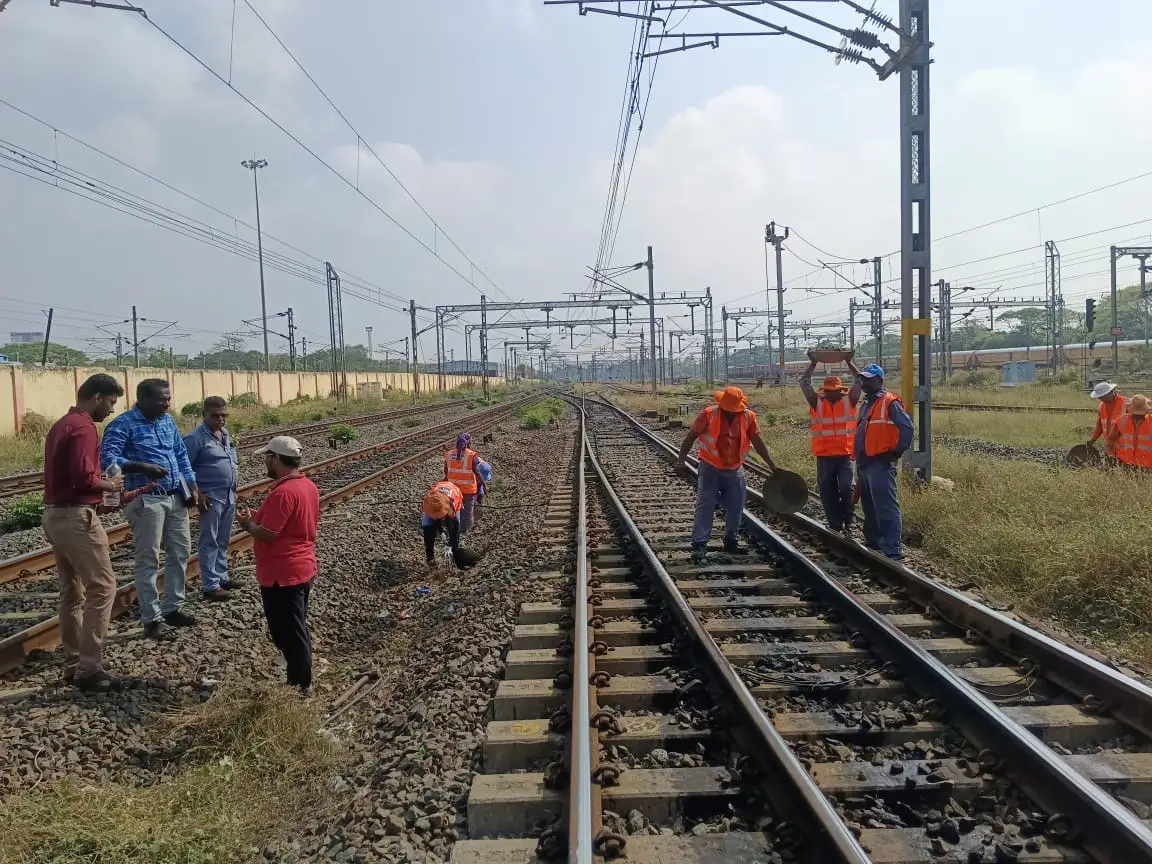
I stood on a live railway track for the first time last year. A train passed on the adjacent line — fast, loud, close enough to feel the pressure wave in my chest.
The workers beside me didn’t look up.
That instinct — or rather, the absence of one — is the entire problem.
The scale of the system
Indian Railways runs 148,706 km of total track, dispatches over 13,000 trains daily, and employs 1.2 million people. The workers at the bottom of that hierarchy — gangmates, gangmen, and keymans — are responsible for keeping every kilometre of that track in service. They work in gangs of 5 to 10, assigned to fixed stretches, maintaining rails, joints, sleepers, and ballast. Keymans patrol their beats solo, often kilometres from the nearest station, often before sunrise.
Both roles operate on or directly beside live tracks — tracks with trains still running on them.
What the data shows
Longitudinal safety data from 2014–15 to 2023–24 tells two stories simultaneously. The headline is real progress: consequential accidents fell from an average of 171 per year in 2004–2014 down to 40 in 2023–24. But within that improvement, direct train collisions remain the most lethal category for on-duty personnel — concentrated at the sharp end, killing the people closest to the impact.
Over ten fiscal years: 36 direct collisions, 15 on-duty employee deaths, an annual fatality rate of 0.12 per 100,000 employees.
| Fiscal Year | Direct Collisions | Employee Deaths |
|---|---|---|
| 2014–15 | 5 | 1 |
| 2015–16 | 3 | 1 |
| 2016–17 | 5 | 2 |
| 2017–18 | 3 | 1 |
| 2018–19 | 0 | 0 |
| 2019–20 | 5 | 1 |
| 2020–21 | 1 | 1 |
| 2021–22 | 2 | 1 |
| 2022–23 | 6 | 0 |
| 2023–24 | 6 | 7 ⚠️ |
| 10-year total | 36 | 15 |
| Annual average | 3.6 | 1.5 |
Source: Railway Board Year Books, synthesized via CAG reports and inquiry coverage. The 2023–24 spike covers Singhpur, Balasore, and Vizianagaram.
A single point of failure
The primary protection mechanism for track workers is a Lookout Man — one gang member designated to watch for approaching trains and signal the rest.
One human. Everyone’s lives. A flag.
That is not a safety system. That is a single point of failure with no redundancy, no fallback, and no tolerance for the human conditions it operates under.
On the Southern Railway sites I visited, workers described three consistent failure modes. Distraction and fatigue: track work is physically intense, repetitive, and done in extreme heat. Sustained vigilance is cognitively impossible to maintain for hours — and the Lookout Man has no task to anchor him, only watchfulness. Over 300,000 posts remain vacant across Indian Railways, pushing crews into extended shifts. Loco pilots have been documented working 12–15 hour stretches, with microsleep — involuntary lapses in consciousness — identified as a causal factor. The Singhpur pilot who died had been on duty for over 14 hours. The same fatigue applies on the ground.
Tool noise: a gang using pneumatic tamping or grinding equipment cannot hear a horn. The work itself masks the warning.
Block overruns: night maintenance blocks are officially closed windows, but in practice communication between the control room and the gang is verbal and imperfect. Trains get cleared before gangs clear the track. At night, headlights are disorienting. A flag is invisible.
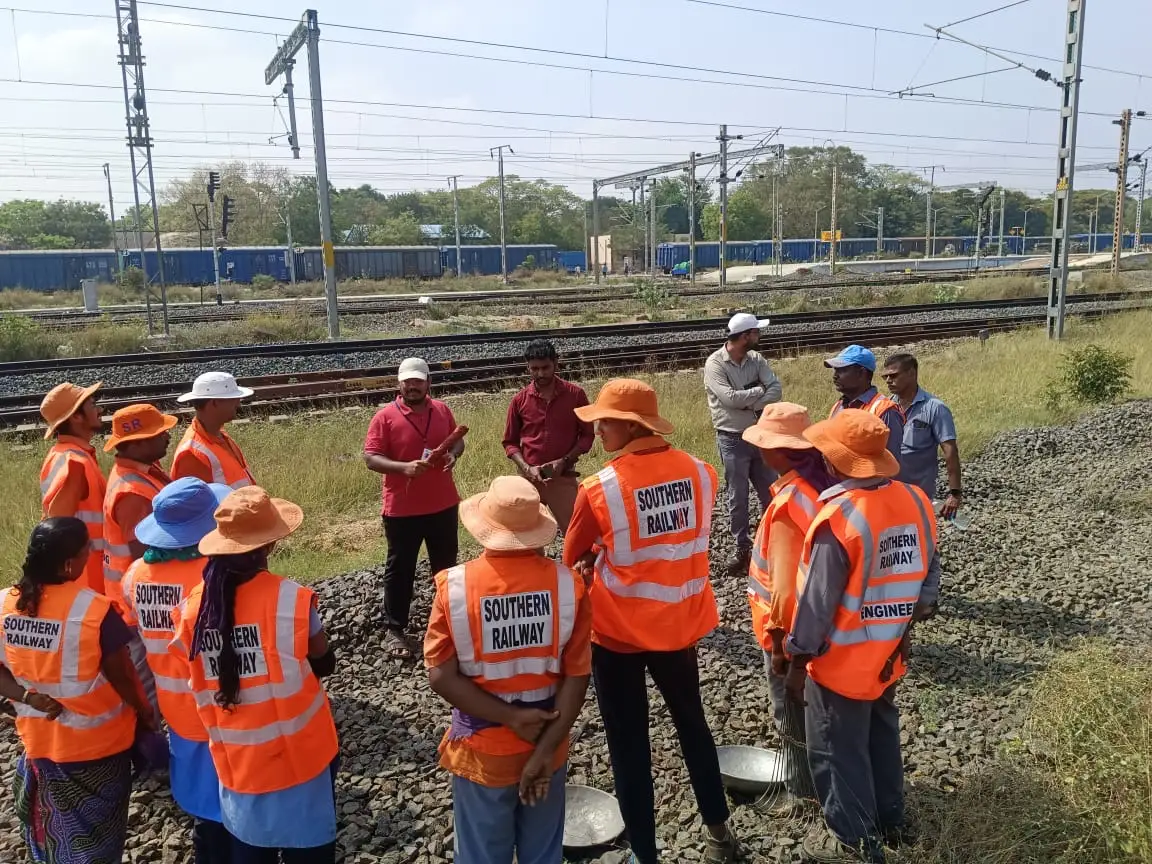
On-track session with gangmates at Southern Railway. Safety here is coordinated verbally, informally — not systematically.
Experience is the wrong variable
The intuitive assumption is that a 20-year veteran is safer than a new recruit. It is wrong.
Habituation — the neurological process by which familiar stimuli stop triggering alert responses — means that experienced workers are less consciously reactive to approaching trains, not more. A new worker flinches at every horn. A veteran’s brain has learned to filter it. Their vigilance has been replaced by pattern recognition, and pattern recognition fails the moment something falls outside the pattern.
One worker put it directly: “When you’re focused on the work, you’re not looking up.”
That is not negligence. That is how attention works. Designing a safety system that depends on sustained human attention is a fundamental design error.
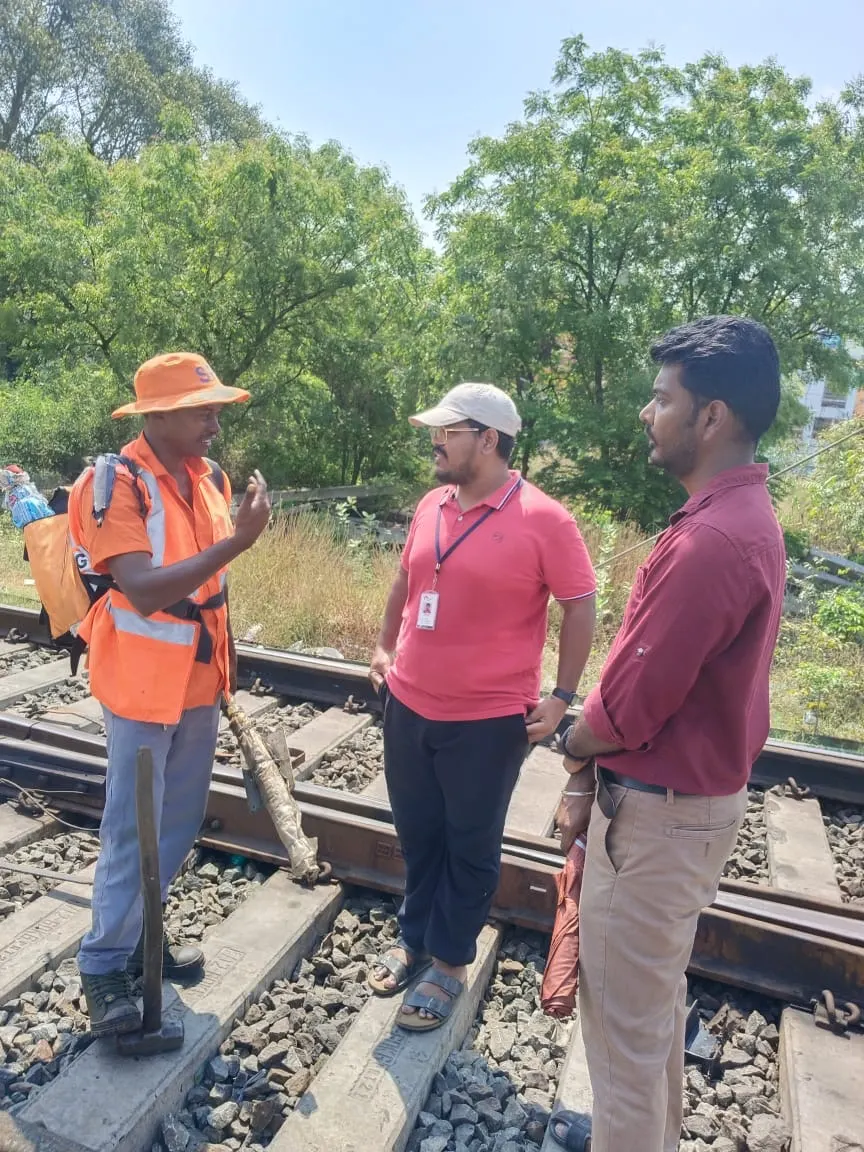
Direct conversation mid-shift. Workers understand the risk completely. That understanding doesn’t make the system safer.
What Kavach doesn’t solve
Indian Railways has invested meaningfully in safety infrastructure. Safety expenditure nearly tripled from ₹39,463 crore in 2013–14 to over ₹1,01,651 crore in 2023–24. Kavach — the Automatic Train Protection system using RFID and radio communication to prevent Signal Passing at Danger events — is a genuine engineering solution for train-on-train collisions. Version 4.0 is deployed on selected high-density corridors.
But Kavach covers train operations. It does not cover the gangmate on the adjacent track. And vast sections of the network remain without it — Vizianagaram being the most recent proof.
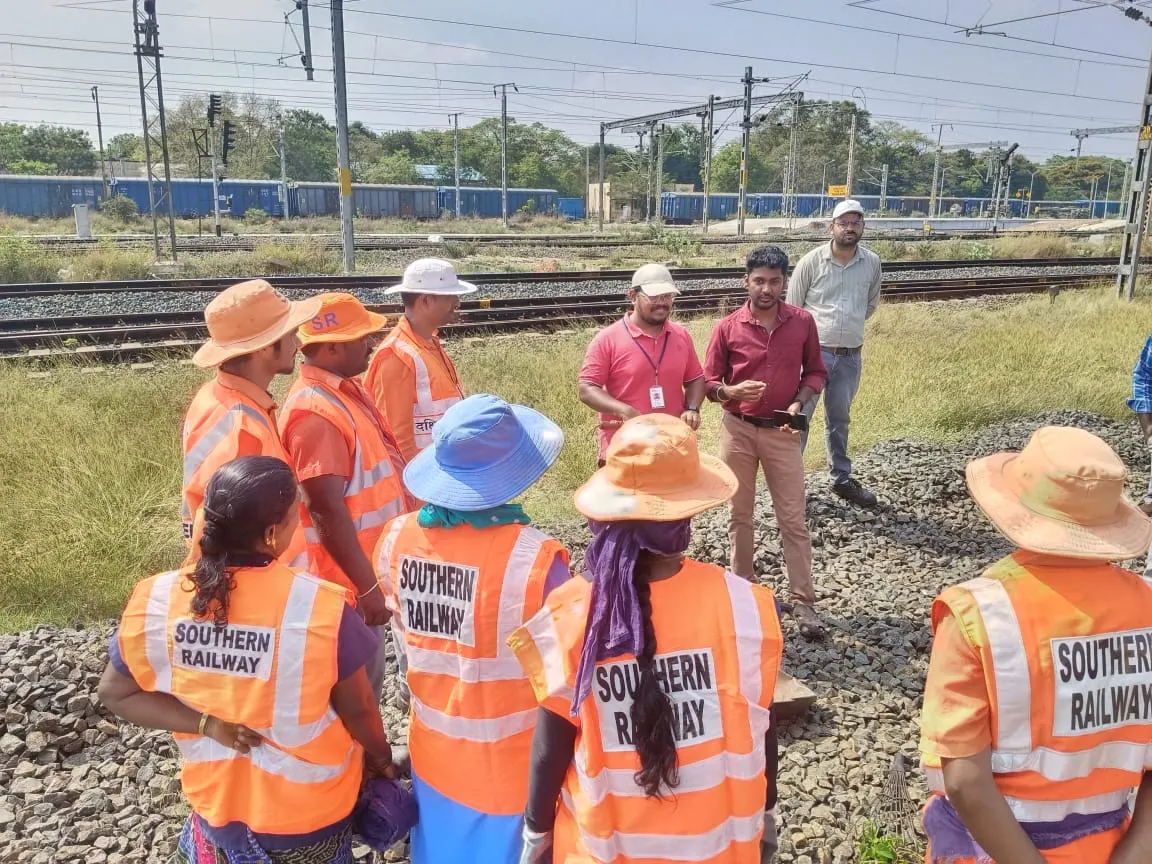
Multiple live tracks, overhead electrification, workers in the middle of it. For these workers, this is the daily environment.
What the solution actually requires
The Operating Ratio at 98.10% and staff costs consuming 72% of working expenses mean there is no slack in this system for expensive, high-maintenance solutions. Any intervention has to be designed for the actual constraint environment, not a lab version of it.
From my conversations on the track, the requirements are clear:
- Attention-independent — if the safety trigger depends on a human noticing something, it will fail
- Offline-first — many track sections have no reliable connectivity; cloud dependency is a non-starter
- Zero workflow friction — workers will not stop to check a device; the system must integrate or be ignored
- Field-ruggedised — dust, heat, monsoon, vibration, zero on-site maintenance
- Fast enough to matter — at 100 km/h, a train travels 28 metres per second; latency is not an engineering detail, it is the difference between life and death
The workers are not careless. The system puts them in a position where being careful is not enough. Between January 2014 and November 2025, the Railways paid ₹12.76 crore in ex-gratia relief to families of the deceased. That is a compensation mechanism, not a safety mechanism.
This is a systems design problem. The constraint is not technology. It is building the right thing for the right user at the right scale — and someone has to care enough to do it.
If you’ve worked on safety-critical hardware, IoT, or low-connectivity systems and want to think through this problem — I’d like to talk.
Based on direct field visits to Southern Railway track maintenance sites. All photos are from on-track sessions with gangmates, keymans, and railway officials.
Sources
- List of railway accidents in India — Wikipedia
- Vizianagaram collision inquiry — The Hindu
- Indian Railways Safety Push — PIB
- Railway Safety at Record High — PIB
- Rail Accidents — Lok Sabha Q. 2935, 2022
- State of Indian Railways — PRS India
- CAG Report No. 22 of 2022 — Derailments
- CAG Report No. 9 of 2025 — Ministry of Railways
- AILRSA — Fatigue and Safety Paper
- Singhpur goods train collision — Times of India
- Balasore triple collision — Wikipedia
- Structural issues in Indian Railways — People’s Dispatch
- 766 dead in rail accidents in 10 years — Outlook India
- Safety in Indian Railways — PRS India Blog